Affiliate disclosure: As an Amazon Associate, this site earns from qualifying purchases linked in this article.
Ready to buy? Check current prices on Amazon and compare deals before you decide.
Navigating the changes of menopause often brings uncomfortable symptoms like hot flashes and night sweats. Many women seek various approaches to manage these experiences, including exploring dietary supplements.
This article provides an evidence-based overview of some commonly discussed supplements for hot flashes and night sweats, focusing on what current research suggests about their potential effectiveness.
Understanding Hot Flashes and Night Sweats in Menopause
Hot flashes, also known as vasomotor symptoms, are a hallmark of the menopausal transition. They are characterized by a sudden feeling of heat that spreads over the body, often accompanied by sweating and flushing. When these occur during sleep, they are referred to as night sweats [1]. These symptoms can significantly impact daily life and sleep quality.
While the exact mechanisms are complex, the decline in estrogen levels during menopause is understood to play a central role in the development of vasomotor symptoms. Many women explore different strategies, including lifestyle adjustments and various supplements, to find relief.

Black Cohosh (Cimicifuga racemosa) for Vasomotor Symptoms
Black cohosh is one of the most widely studied herbal supplements for menopausal symptoms, particularly hot flashes and night sweats [2]. It has a long history of traditional use and is frequently recommended for menopausal discomfort.
Several reviews and meta-analyses have explored the effects of black cohosh extracts. A 2023 meta-analysis suggested that black cohosh extracts may offer some benefit in reducing menopausal symptoms [3]. Another review from 2021 also indicated that an isopropanolic black cohosh extract (iCR) showed positive effects on menopausal symptoms [4]. However, the strength of the evidence can vary, and some studies show mixed results or suggest modest benefits.
It’s important to note that the efficacy of black cohosh can depend on the specific extract and dosage used. The safety picture needs more care than a single line can carry. The systematic review cited here reached a conditional conclusion rather than a general one: black cohosh appeared safe in breast cancer patients without risk for liver disease, and the same authors described concerns about liver toxicity as inconclusive [5]. That qualifier matters, because products labelled as black cohosh have been implicated in cases of clinically apparent acute liver injury, some severe enough to lead to emergency liver transplantation or death, which is why the National Institute of Diabetes and Digestive and Kidney Diseases maintains a dedicated LiverTox monograph on it [6]. A 2024 analysis in JAMA Network Open lists black cohosh among the six botanicals most frequently reported in herb-induced liver injury in the United States [7].
Causality is contested rather than settled, and the disagreement is worth knowing about. A structured review of the early reported cases, scored with the CIOMS causality scale, concluded that causality was not established in any of them and pointed instead to authentication and adulteration problems in some products [8]. Later cases assessed individually have documented liver enzymes returning to normal once the supplement was stopped [9]. What the sources agree on is the practical guidance: anyone with existing liver disease should avoid black cohosh, and anyone taking it should stop and seek medical care if jaundice, dark urine, unusual fatigue or right-sided abdominal pain develops.
Interactions with other medications, and whether black cohosh is appropriate at all given your own medical history, are worth discussing with a healthcare provider before starting.
Red Clover (Trifolium pratense) and Isoflavones
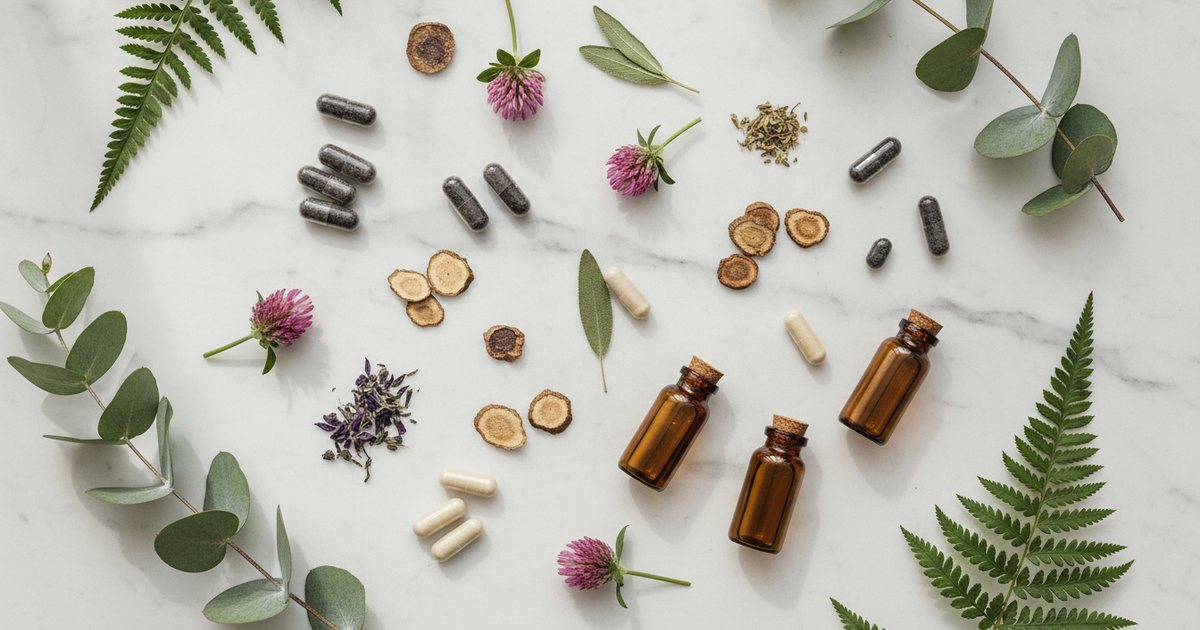
Red clover is another plant-based supplement that has garnered attention for its potential to help with menopausal hot flashes and night sweats. Its benefits are often attributed to its content of isoflavones, which are plant compounds that can have estrogen-like effects in the body [10].

Research on red clover has shown varying outcomes. A systematic review and meta-analysis published in 2021 evaluated red clover extract for relieving hot flashes and other menopausal symptoms. This review found some evidence suggesting that red clover may offer a clinically meaningful improvement for hot flashes in some women [11].
More recent research, such as a 2024 prospective randomized placebo-controlled trial, indicated that isoflavones obtained from red clover improved both dyslipidemia and menopausal symptoms in menopausal women [10]. A broader meta-analysis in 2015 also looked at phytoestrogens, including those found in red clover, and found some efficacy for menopausal symptoms [12]. As with any supplement, individual responses can differ.
Considerations for Supplement Use
When considering supplements for menopausal symptoms, it’s crucial to remember that results can vary significantly from person to person. Factors such as individual body chemistry, the specific formulation of the supplement, and dosage can all play a role in outcomes. The evidence for many supplements, while promising in some areas, is often moderate and can be influenced by study design and size [1].
The quality and purity of supplements can also differ widely between brands. It is always recommended to choose products from reputable manufacturers and to discuss any supplement use with a healthcare professional to ensure it is appropriate for your individual health needs and to avoid potential interactions with other medications [1].
References
- Complementary and Alternative Medicine for Menopause. The Nursing clinics of North America, 2024
- Exploring the Efficacy and Safety of Black Cohosh (Cimicifuga racemosa) in Menopausal Symptom Management. Journal of mid-life health, 2024
- Black cohosh extracts in women with menopausal symptoms: an updated pairwise meta-analysis. Menopause (New York, N.Y.), 2023
- Review & meta-analysis: isopropanolic black cohosh extract iCR for menopausal symptoms – an update on the evidence. Climacteric : the journal of the International Menopause Society, 2021
- Black cohosh (Cimicifuga racemosa [L.] Nutt.): safety and efficacy for cancer patients. Supportive care in cancer : official journal of the Multinational Association of Supportive Care in Cancer, 2007
- Black Cohosh. LiverTox: Clinical and Research Information on Drug-Induced Liver Injury, NIDDK, 2012, chapter updated 2025
- Estimated Exposure to 6 Potentially Hepatotoxic Botanicals in US Adults. JAMA network open, 2024
- Herb induced liver injury presumably caused by black cohosh: a survey of initially purported cases and herbal quality specifications. Annals of hepatology, 2011
- Case of cholestatic drug-induced liver injury (DILI) associated with black cohosh. BMJ case reports, 2021
- Isoflavones obtained from red clover improve both dyslipidemia and menopausal symptoms in menopausal women: a prospective randomized placebo-controlled trial. Climacteric : the journal of the International Menopause Society, 2024
- Evaluation of Clinical Meaningfulness of Red Clover (Trifolium pratense L.) Extract to Relieve Hot Flushes and Menopausal Symptoms in Peri- and Post-Menopausal Women: A Systematic Review and Meta-Analysis of Randomized Controlled Trials. Nutrients, 2021
- Efficacy of phytoestrogens for menopausal symptoms: a meta-analysis and systematic review. Climacteric : the journal of the International Menopause Society, 2015
These statements have not been evaluated by the Food and Drug Administration. This information is not intended to diagnose, treat, cure, or prevent any disease. Content is for informational purposes only and is not medical advice; consult a qualified healthcare provider before starting any supplement. As an Amazon Associate we earn from qualifying purchases.
